III – PROCEDURES
PART 1
: Early Studies – Mutants, Microorganisms and Restrictions in Plant Studies
Early studies in the biosynthesis of the indole alkaloids, especially in the steps leading up to the formation of tryptophan were generally performed on microorganisms, this in the light that the first enzyme purified came from the bean plant. The reasoning behind this was mainly in the large number of difficulties that were encountered in the study of biosynthetic pathways in plants. The obvious problems include a fairly slow rate of reproduction and large biomass in comparison to microorganisms, although the following list delineates the unassailable problems behind use of plants in biochemical studies at the time:
- lack of sufficient plant material (especially in the light of the low percentages of products produced/mass of plant material)
- too large a variety of metabolic paths and transformations in plants – the microorganisms had the advantage of being simpler in their paths and products, and so new studies tended to focus on easier understood material
- difficulties in rupturing cellulose-containing cell walls without damaging other organelles, such as vacuoles – this was a problem completely specific to plants, and lead to the next difficulty noted especially with the rupturing of vacuoles and peroxisomes
- presence of a large number and variety of secondary metabolites which tended to inactivate enzymes, making it impossible to discover some enzyme activities at all – once particular enzymes had been identified in other organisms this problem became less, as the enzyme could simply be assumed to be present, extracted isolated and reactivated
- General path elucidation
The first major breakthrough in methods used in determination of biosynthetic paths was B.D. Davis’ realization that the ability of penicillin to sterilize only growing bacteria could be utilized. He reasoned that if a culture of bacteria were mutated through irradiation and then transferred to a minimal medium of glucose and wild-type required salts, then auxotrophic mutants, lacking the proper resources would halt their growth rate. Addition of penicillin would only kill the growing, wild-type bacteria, leaving the mutated bacteria. These mutants could then be isolated by testing their growth on a on a variety of mediums containing possible biosynthetic precursors. This ability to isolate nutritionally deficient mutants allowed for culturing of bacteria which required one of the aromatic amino acids (Phe, Tyr, Trp) as part of its growth medium. Soon it was discovered that in many of these microorganisms, shikimic acid was able to replace the required aromatic supplements and the shikimic acid path began to be elucidated.
Of course, the work involved in the elucidation of these paths was more complex than this, and a set of "rules" to work by was developed, which will be explained here and then applied to one of the last intermediates to be identified, chorismic acid. It was quickly discovered that auxotrophic mutants tended to accumulate certain substrates given to them, and that these substances often occurred at or before a block in the metabolic pathway, while the substances they depended on occurred at or after the same block in the pathway. The "one-step mutants", which were most common and most useful were used to eliminate certain possibilities as metabolic products of a certain step, by noting that the compound did not fulfill the nutritional requirement of the auxotroph lacking that step. They were also used to determine which compounds were metabolic precursors by noting which substances tended to accumulate. The following generic biosynthetic scheme used by D.B. Davis can be used to explain this reasoning:
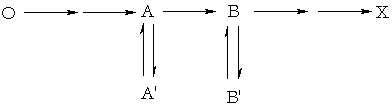
Scheme 14: Generic Biosynthetic Pathway
In this schematic, a wild type enzyme that was shown (by isotopic, nutritional or enzymatic methods) to be able to convert A and B to X would also by default have an enzyme that was able to convert A to B, say B synthase. An auxotrophic mutant lacking the enzyme B synthase would result in an inability to synthesize X, and therefore a nutritional dependence on either X or any of the intermediates between B and X. It would also be found to accumulate A when fed any precursor to this step, such as O. However, one factor which often arose was misinformation through isolation of "false-intermediates", such as A’. In these cases, A’ could appear to be the intermediate due to accumulation at the blocked point in the pathway, but in reality would only be a side reaction of the real intermediate, A. Examples of this include tautomerisms and rearrangements which are common not only in the organism itself, but as a result of the methods used in extraction and analyses of metabolites.
In the case of chorismate, blockage by mutation resulting in loss of activity in enzymes catalyzing chorismate formation lead to an auxotroph with multiple requirements for all the aromatic amino acids.
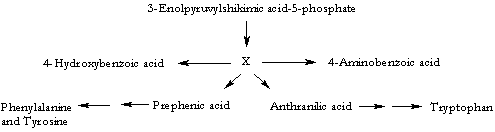
Scheme 15: Pathway from 3-Enolpyruvylshikimic acid-5-phosphate to the Aromatic Amino Acids Prior to the Discovery of Chorismate as a General Precursor
A few mutants were originally assayed which required all of the aromatic amino acids, but these always occurred as either multiple blocks, or were blocked before compound "X". Finally, in 1964, a mutant was isolated which was blocked just prior to prephenic acid (ie. it required only phenylalanine and tyrosine as nutritional supplements), and which was found to accumulate a new compound which was quickly isolated and identified as chorismic acid. As a final test, it was supplied to mutants blocked at the formation of 3-enolpyruvylshikimic acid-5-phosphate and was found to supplement for all the aromatic amino acid requirements of this auxotroph.
- Specific Enzyme Assays
For the large part, determination of the activity of each of the enzymes in the pathway from chorismate to the indole alkaloids was dependant on each researchers specific knowledge about the substrates and products of the enzyme. This led to a large variety of unique and often quite creative methods used in assaying for Vmax and Km values as well as assays used for identification, during purification of the proteins.
Many of the enzymes in the pathway were assayed using fluorometric, UV or spectrophotometric determinations, measuring either formation or disappearance of a compound with known activation (absorbance) and emission wavelengths. Examples of this include assays of anthranilate synthase by increases in emission from anthranilate, PR transferase by decrease in emission from anthranilate and InGP synthase by increased absorption from InGP. To resolve cases where absorbance or emission characteristics were similar, as in the case of CdRP formation from PRA, the reactions were often coupled with an excess of an enzyme able to produce a product which could be assayed for. Two examples occurring in these studies are coupling of PRA isomerase with excess InGP synthase, with InGP being assayed for spectrophotometrically and coupling of tryptophan synthase with glyceraldehyde-3-phosphate dehydrogenase, with 1,3-bisphosphoglycerate being the compound which was assayed for spectrophotometrically. Through these couplings of various enzyme systems, most of the steps involved in these syntheses could be characterized.
PART 2: Labeling Studies – Direct Labeling, Decomposition, Isotopic Competition, Spectroscopy
Labeling studies allowed for some of the first extensive studies on plant biosynthetic pathways. Since the feasibility of working with auxotrophic mutants of plants was quite low and due to many of the reasons previously mentioned, the use of nutritional studies in plant biochemical determinations was negligible. During the 1950’s this field expanded noticeably with the availability of radioactive tracers, most commonly in the form of 3H and 14C. Using these compounds, two main techniques were used to elucidate pathways, direct labeling followed by degradation and isotopic competition.
Direct labeling involved feeding a radioactively labeled intermediate which was considered a possible precursor to the step being studied, followed by isolation of the radioactive product and determination of its structure through chemical degradation methods such as ozonolysis, decarboxylation and Hofmann degradation. For example, the tryptophan decarboxylase activity of Phalaris tuberosa was measured by looking at production of 14C-tryptamine from methylene-14C-L-tryptophan and 14CO2 production from carboxyl-14C-DL-tryptophan.
Isotopic competition used a slightly different technique. Here, the precursor was fed to the organism "cold", while the general carbon pool source was given in its radioactive form. If the radioactivity levels of the product dropped with increased precursor feeding the evidence pointed to the organisms use of this precursor for the product in question, since it would be the only compound without radioactive labels. A study that used this particular technique was a study on tryptophan biosynthesis in Nicotiana tabacum. Cell cultures of this plant were fed sucrose-U-14 as a general carbon source and then a variety of non-radioactive precursors to tryptophan (including L-tryptophan itself, indole, anthranilic acid, shikimic acid and InGP) to determine what effect they would have on the total radioactivity levels in tryptophan. In this case, D-tryptophan and L-leucine were added cold as control substances, to make sure that the proper enzyme was being assayed). Sodium acetate was also added cold at the same concentrations as the tested precursors to make sure that they were not simply being degraded and used as general carbon sources.
In the 1970’s, the availability of 13C as an isotopic label created a further refinement in labeling studies. Since this isotope has a natural spin of I=1/2, any compound with this label would be identifiable on a 13C NMR spectrum, provided the machinery was sensitive enough. This lessened the work involved and increased the efficiency, since it removed any need for degradation of products, the compounds in question were simply identified spectrometrically and their relative concentrations and/or amounts could be determined based on the chemical properties of the compound itself, rather than the degraded products. This mechanism has been used in determining mechanisms involved in indole alkaloid pathways of TIA producing plants, where it has been particularly useful due to the complexity of the molecules involved.
Overall these techniques added greatly to the methods available to determination of biosynthetic pathways, especially in relevance to plants. However, the following limitations had to be kept in mind with in vivo tracer studies:
- there is often disturbance of the natural metabolism due to the great increase in concentrations of the added compounds
- some results can be misleading due to permeability limitations of the compounds added
PART 3: Further Studies – Blot Analyses
More recent work in the field of indole alkaloid biosynthesis has focused on the molecular level, with newmethods emerging to allow for this work to continue. Three major types of blot analyses are used in determining characteristics of DNA, mRNA and proteins involved in these paths. They are the Southern, northern and western blot analyses respectively.
To determine if a specific sequence of DNA is present in a sample being studied, Southern analysis is usually used. First, the DNA that is to be checked is digested with restriction enzymes and then separated using gel electrophoresis. These DNA segments are then transferred to a membrane of some sort for ease of handling with "lateral" electrophoresis. The filter is then probed with labeled fragments of the DNA, which is being searched for, the labeled DNA base-pairs to the sequence that it matches and it can then be detected with whatever method is being used, such as radioactivity. This procedure must be repeated with several different restriction enzymes to statistically eliminate the possibility of cuts resulting in false positive matches. The information obtained from this analysis gives the positive or negative identification of particular gene sequences within a genome, as well as the number found therein. This method has been used in studies of the b -subunit of tryptophan synthase in Camptotheca acuminata.
In the northern blot analysis, a similar procedure is employed, only this time detection of mRNA is the goal. No restriction enzymes are required due to the small size of the mRNA segments, so the material is simply separated with gel electrophoresis. The resulting bands are transferred to a membrane as in the Southern blot analysis and are then probed with labeled mRNA fragments. These bind more easily to the mRNA segments being searched for than in the Southern blot analysis, which requires some sort of activation since the mRNA is found as a single strand already. Unlike the Southern blot analysis, the northern analysis does not determine anything to do with the genome itself, but rather gives information about the amount of expression of the gene in question in the tissue sampled. This technique was used to determine what factors regulated expression of tryptophan decarboxylase in Camptotheca acuminata.
The last type of blot analysis commonly used is western blot analysis. This is generally used to quantitatively determine protein occurrence in a specific tissue. As with the other two analysis, the material to be examined (proteins) are separated by weight with gel electrophoresis and then transferred to a membrane. Previous to this, antibodies are raised which have action against the protein to be studied, as are antibodies against the general type of antibody raised against the protein. For example, in a study of tryptophan decarboxylase, antibodies against this enzyme may be raised in rabbits, this would be the antibody which is specific to the protein being studied. At the same time, antibodies would also be raised against rabbit antibodies in general, in another species of animal. The membrane is first probed with the antibodies specific to the protein of interest, which they would bind to. Then, the general "anti-antibody" which has been engineered to produce a product that can be assayed, is used to probe for the first antibody, and thereby attach secondarily to the protein being studied. The only reason that such a complex procedure is used is that it allows for the study of multiple proteins without engineering of an antibody for each assay, the general antibody can be used as the observable factor in all studies. This analysis was also used in the study of tryptophan decarboxylase regulation in Camptotheca acuminata, to determine protein levels at different ages of the plants. With the information gained from the western analysis, it was possible to determine which age of the plant would be best to use for extraction of appreciable levels of the required mRNA related to the protein occurrence, tdc.
Further methods have developed and continue to do so around this biosynthetic pathway, especially in rapidly developing field of biotechnology. Here, the increasing desire for an ability to control production of secondary metabolites, especially the alkaloids has led to the development of methodologies related to plant cell culture (micropropagation) and genetic transformations. Hopefully these new techniques will lead to a further understanding of some of the unexplored characteristics of the biosynthesis of the indole alkaloids.